Sir Frederick Ashton was a commanding presence in the growth of The Royal Ballet from its humble origins in the 1930s, to his role as its director from 1963 to 1970 when it became one of the greatest companies in the world. A gifted dancer and choreographer of genius, he created more than 100 ballets over a 60-year career, including Cinderella, La Fille mal gardée and Sylvia.
His choreography is characterised by its synthesis of modern and classical form, and by its wit, lyricism and elegance. His ballets are at once extremely sophisticated and widely popular. He developed a personal style, which has become known as the ‘English style, characterised by its poise, purity of line and freshness, its use of the shoulders and torso, and for its fast, intricate footwork.
Ashton was always of his time but loved the idioms of the past: Cinderella pays homage to the great three-act classical ballets of Petipa, La Fille mal gardée recreates one of the most famous ballets of the 18th century.
Ashton combined the sophistication of such French and Russian models with an Englishman’s disregard for high aesthetics: the wonderfully eccentric chicken dance from La Fille mal gardée, for example. Above all, his ballets communicate a sense of carefree enjoyment and fun.
Tuesday, 22 November 2011

Giselle Storyline
Act I
A pleasant valley in Germany
In Germany, it is a tradition to celebrate the vine harvest by drinking new wine at a different cottage in the village each day. The cottage selected was marked by a wreath with a wine jug in the centre hanging over the door. On this occasion the cottage where the peasant girl Giselle lives with her Mother, Berthe, is to be the scene of the celebration.
Giselle has fallen in love with Albrecht, Duke of Silesia, who, disguised as a peasant and using the hut opposite Giselle's cottage to hide his nobleman's dress, courts the unsuspecting girl. Hilarion, a gamekeeper who suspects the identity of his rival, is also in love with Giselle. The vintagers return with the last gathering of grapes and join Giselle and Albrecht in a dance but Giselle's mother is afraid that her passion for dancing will kill her delicate daughter who will then fall under the spell of the Wilis. The peasants are frightened by this but Giselle is amused at her mother's concern, and continues to celebrate the wine harvest and is crowned Queen of the Vine.
The Prince of Courland with his daughter, Bathilde, and hunting party stop at Giselle's cottage to taste the new wine. Giselle admires Bathilde and her clothes not knowing that she is engaged to Duke Albrecht. When Hilarion unmasks the true situation the shock is too great for Giselle who loses her reason and dies.
Act II
A forest clearing beside a pool at night
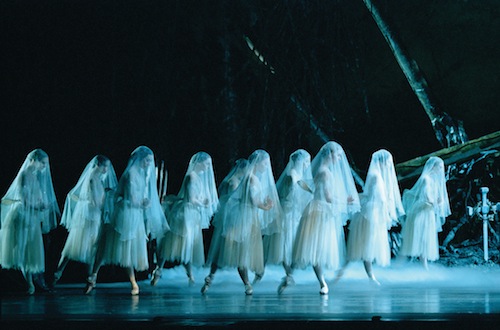
Beneath some tree stands a cross on which is carved the name, Giselle. Hilarion mourns Giselle at her tomb but an air of mystery pervades the forest and wilis, led by their queen, Myrtha, appear. The wilis are supernatural vampire-like spirits of betrothed girls who have been inordinately fond of dancing and died as the result of being jilted by faithless lovers.
Attired in their bridal dresses, they dance in the moonlight, determined to be revenged on all men. They lure any passers by to their part of the forestand force them to dance until they collapse from exhaution and die. Albrecht, too, visits Giselle's grave, repenting of the part he played in her death. Both Hilarion and Albrecht are trapped by the Wilis. For Hilarion there is no escape. Giselle's deep love for Albrecht saves him from the power of the relentless Queen and her attendant wilis. With the coming of dawn the wili's power is ended and they disappear leaving Albrecht to take a last farewell of Giselle.
A pleasant valley in Germany
In Germany, it is a tradition to celebrate the vine harvest by drinking new wine at a different cottage in the village each day. The cottage selected was marked by a wreath with a wine jug in the centre hanging over the door. On this occasion the cottage where the peasant girl Giselle lives with her Mother, Berthe, is to be the scene of the celebration.
Giselle has fallen in love with Albrecht, Duke of Silesia, who, disguised as a peasant and using the hut opposite Giselle's cottage to hide his nobleman's dress, courts the unsuspecting girl. Hilarion, a gamekeeper who suspects the identity of his rival, is also in love with Giselle. The vintagers return with the last gathering of grapes and join Giselle and Albrecht in a dance but Giselle's mother is afraid that her passion for dancing will kill her delicate daughter who will then fall under the spell of the Wilis. The peasants are frightened by this but Giselle is amused at her mother's concern, and continues to celebrate the wine harvest and is crowned Queen of the Vine.
The Prince of Courland with his daughter, Bathilde, and hunting party stop at Giselle's cottage to taste the new wine. Giselle admires Bathilde and her clothes not knowing that she is engaged to Duke Albrecht. When Hilarion unmasks the true situation the shock is too great for Giselle who loses her reason and dies.
Act II
A forest clearing beside a pool at night
Beneath some tree stands a cross on which is carved the name, Giselle. Hilarion mourns Giselle at her tomb but an air of mystery pervades the forest and wilis, led by their queen, Myrtha, appear. The wilis are supernatural vampire-like spirits of betrothed girls who have been inordinately fond of dancing and died as the result of being jilted by faithless lovers.
Attired in their bridal dresses, they dance in the moonlight, determined to be revenged on all men. They lure any passers by to their part of the forestand force them to dance until they collapse from exhaution and die. Albrecht, too, visits Giselle's grave, repenting of the part he played in her death. Both Hilarion and Albrecht are trapped by the Wilis. For Hilarion there is no escape. Giselle's deep love for Albrecht saves him from the power of the relentless Queen and her attendant wilis. With the coming of dawn the wili's power is ended and they disappear leaving Albrecht to take a last farewell of Giselle.
Wednesday, 2 November 2011
Tuesday, 1 November 2011
Giselle
Giselle is one of the most important and popular ballets in history. It appeared when French ballet had just undergone a revolution with Marie Taglioni‘s appearance as a ghostly Mother Superior in the “Ballet of the Nuns” (from Act III of Meyerbeer’s 1831 opera Robert le Diable) where nuns in white tutus came to life in a 16th century moonlit cloister. Taglioni’s fluid and effortless dancing gave the illusion of weightlessness and caused a great sensation, paving the ground for the great “white ballets” from classical dance’s Romantic period. Giselle and La Sylphide (also led by Marie Taglioni) inspired ballets like La Fille du Danube, L’Ombre, La Gitana and La Péri, stories that depicted the impossible love between mortals and elusive fantastic creatures set in earthly backdrops of alpine villages, Scottish highlands and Spanish riverbanks and that borrowed heavily from Romantic poetry and painting.

http://www.theballetbag.com/wp-content/uploads/2011/01/BC-Gis.jpg
Giselle ou Les Wilis premiered at the Paris Opera on 28 June, 1841 with Carlotta Grisi as Giselle, Lucien Petipa (brother of Marius) as Albrecht and Adèle Dumilâtre as Myrtha. The ballet was immediately declared not only a worthy successor to La Sylphide but also “the greatest ballet of its time”, a triumphant reception. Giselle remained in the Paris Opera repertoire until 1849. When it became outmoded the ballet was completely dropped (after 1868); it would only be seen again in Paris decades later as part of the Ballets Russes’ second Paris season, with Karsavina and Nijinsky in the lead roles.
Following its success in Paris Giselle toured around Europe, traveling as far as the Imperial Theatre in St. Petersburg. This particular 1842 production was staged by Titus, a ballet master who recreated the ballet from memory. But in 1848, with Jules Perrot coming into the Imperial Theatres as ballet master, a new Russian version of Giselle was staged with Marius Petipa as Albrecht. This Giselle stayed in repertory until 1859 when Perrot returned to Paris. Next came Marius Petipa’s 1862 version, with several alterations to cater for the Italian virtuoso ballerinas of the time, most notably, the insertion of the Act I Giselle variation as we know it.
Information from:
http://www.theballetbag.com/2011/01/11/giselle/
http://www.theballetbag.com/wp-content/uploads/2011/01/BC-Gis.jpg
http://www.theballetbag.com/wp-content/uploads/2011/01/BC-Gis.jpg
Giselle ou Les Wilis premiered at the Paris Opera on 28 June, 1841 with Carlotta Grisi as Giselle, Lucien Petipa (brother of Marius) as Albrecht and Adèle Dumilâtre as Myrtha. The ballet was immediately declared not only a worthy successor to La Sylphide but also “the greatest ballet of its time”, a triumphant reception. Giselle remained in the Paris Opera repertoire until 1849. When it became outmoded the ballet was completely dropped (after 1868); it would only be seen again in Paris decades later as part of the Ballets Russes’ second Paris season, with Karsavina and Nijinsky in the lead roles.
Following its success in Paris Giselle toured around Europe, traveling as far as the Imperial Theatre in St. Petersburg. This particular 1842 production was staged by Titus, a ballet master who recreated the ballet from memory. But in 1848, with Jules Perrot coming into the Imperial Theatres as ballet master, a new Russian version of Giselle was staged with Marius Petipa as Albrecht. This Giselle stayed in repertory until 1859 when Perrot returned to Paris. Next came Marius Petipa’s 1862 version, with several alterations to cater for the Italian virtuoso ballerinas of the time, most notably, the insertion of the Act I Giselle variation as we know it.
Information from:
http://www.theballetbag.com/2011/01/11/giselle/
http://www.theballetbag.com/wp-content/uploads/2011/01/BC-Gis.jpg
Subscribe to:
Comments (Atom)